A Page of Madness - Live Metal Score
Teinosuke Kinugasa's 1926 silent film 'A Page of Madness' screened with a live metal score at Row House Cinema in Pittsburgh.
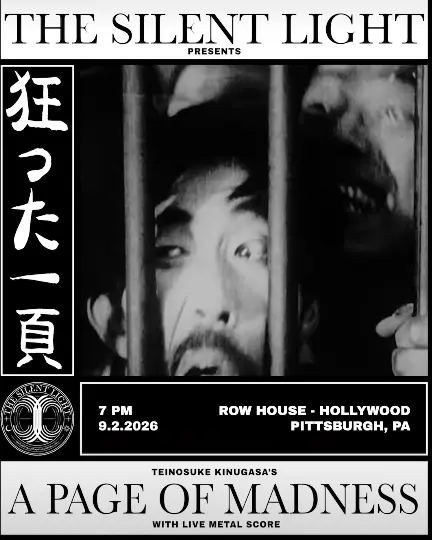
If you caught @thesilentlightmusic at our grand opening in November, you KNOW we're excited to announce another event with them pairing live music with a classic silent film — A PAGE OF MADNESS
7 pm - September 2 - $25
at Row House - Hollywood
Experience Kinugasa’s lost 1926 silent horror masterpiece A Page of Madness like never before, reimagined with a blistering live metal and electronic score by The Silent Light.
About The Silent Light
Founded in 2015 by Michael Formanski, The Silent Light is a musical endeavor that breathes new life into classic silent films through the power of heavy metal. Formanski, composer and film director, crafts each score drawing from the dark and intense realms of black metal, doom metal, and original fantasy soundtracks with influences such as The Body, Sunn O))), Emperor, Summoning, and Nobuo Uematsu. Accompanying Formanski is Matt Hardy, the steadfast drummer who has been a key member for the past several years, along with a rotating ensemble of skilled musicians who contribute to the project’s ever-evolving sound.
The Silent Light’s performances transform silent films like Metropolis, Faust, and Nosferatu into contemporary masterpieces with their haunting and powerful metal scores. They continue to push the boundaries of what silent film scoring can be, inviting audiences to experience the classics in a way they never have before.
About The Film
A Page of Madness was directed by Teinosuke Kinugasa, and originally premiered in 1926. The film centers on a janitor working at an asylum, his wife, who is a patient there, and their daughter, who visits regularly. For the janitor, taking the job at the asylum was the only way he could stay close to his wife, who no longer remembers who he is.
Within just a few years of its release, every known print of the film had disappeared. For nearly 50 years the film was believed to be lost, until Kinugasa rediscovered a copy that had been stored in a rice barrel in his cabin in 1971. The version that survives is incomplete, missing roughly a third of the original material, and contains no dialogue or inter-titles. What remains is a feverish, expressionist journey into the mind.
7 pm - September 2 - $25
at Row House - Hollywood
Experience Kinugasa’s lost 1926 silent horror masterpiece A Page of Madness like never before, reimagined with a blistering live metal and electronic score by The Silent Light.
About The Silent Light
Founded in 2015 by Michael Formanski, The Silent Light is a musical endeavor that breathes new life into classic silent films through the power of heavy metal. Formanski, composer and film director, crafts each score drawing from the dark and intense realms of black metal, doom metal, and original fantasy soundtracks with influences such as The Body, Sunn O))), Emperor, Summoning, and Nobuo Uematsu. Accompanying Formanski is Matt Hardy, the steadfast drummer who has been a key member for the past several years, along with a rotating ensemble of skilled musicians who contribute to the project’s ever-evolving sound.
The Silent Light’s performances transform silent films like Metropolis, Faust, and Nosferatu into contemporary masterpieces with their haunting and powerful metal scores. They continue to push the boundaries of what silent film scoring can be, inviting audiences to experience the classics in a way they never have before.
About The Film
A Page of Madness was directed by Teinosuke Kinugasa, and originally premiered in 1926. The film centers on a janitor working at an asylum, his wife, who is a patient there, and their daughter, who visits regularly. For the janitor, taking the job at the asylum was the only way he could stay close to his wife, who no longer remembers who he is.
Within just a few years of its release, every known print of the film had disappeared. For nearly 50 years the film was believed to be lost, until Kinugasa rediscovered a copy that had been stored in a rice barrel in his cabin in 1971. The version that survives is incomplete, missing roughly a third of the original material, and contains no dialogue or inter-titles. What remains is a feverish, expressionist journey into the mind.
Photos

